present a detailed, critical analysis of a cultural text

Described by its creators as a “kung-fu movie trailer”, Coldplay’s Princess of China is punctuated with scenes reminiscent of kung-fu movie classics such as Crouching Tiger and House of Flying Daggers and Rihanna dressed in a sexualized variation of an “Asian-inspired” traditional garment. I have chosen to analyse this cultural text as instances of orientalism and cultural appropriation as well as misrepresentation of aspects of several eastern cultures are exhibited, particularly through the exotic depiction of Rihanna as a female from the Orient.
The essence of Orientalism is that Western knowledge of and representation of the East comes not from direct experience of the Orient but from Orientalist discourse created out of prejudice and discrimination in the context of Western political dominance over the Orient. It is “a style of thought based upon an ontological and epistemological distinction made between the Orient’ and (most of the time) ‘the Occident’.” (Orientalism, 2003, p. 2). It is a European construct of ‘Otherness’. Asia is not defined by what Asia is, but rather what it isn’t in contrast with the Western norm, rendering it as foreign, mysterious and exotic. These preconceived models that imagine all Eastern societies and cultures as homogenous (and secondly, fundamentally antithetical to the West) is the basis of my interest text as it is reflected in the styling and portrayal of the lead woman.
Throughout the video Rihanna can be seen dressed in highly stylized and overly-sexualized garments and embellished in accessories not limited to one culture. This is obviously not a purist reflection of any Asian tradition or background in their true form but a re-imagination of the surface aesthetics of a wide range of eastern cultures through a Hollywood lens. Considering that the song for which the video is created for is called Princess of China, one would rightly expect it to be primarily inspired by that of Chinese culture and traditions. Instead the viewer is bombarded with an amalgamation of stereotypical Asian tropes and symbols selectively picked and chosen from several countries such as Taiko drummers and samurais, which are inherently Japanese, dance moves reminiscent of Balinese traditional dance, all juxtaposed within the grounds of an ‘Asian’ temple decorated with ‘Asian’ lanterns.
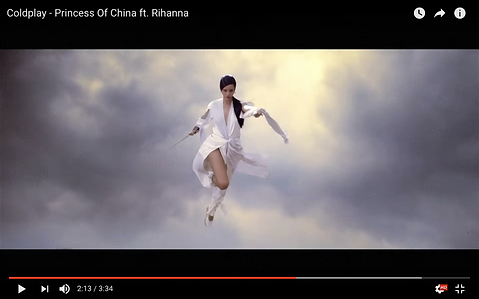
Although this video was created with the intention of ‘honouring’ Asian culture, a homage of sorts, I see this homogenization and generalization of distinct sets of cultural groups as an example of modern day Orientalism present in popular culture. To me, the creators have adopted quite an ethnocentric approach towards the Asian cultures they have imitated by relying on stereotypes and aspects of those cultures – such as ninjas and samurais - commonly depicted in the media, and the fact that they’ve acknowledged this nonprescriptive way of representation in a Rolling Stones interview about their thought process and idea behind the video communicates an ignorance which shouldn’t be dismissed.
Furthermore, it should be acknowledged that many racist Asian stereotypes prevalent in today’s society finds its roots within the over-arching Orientalism that persists in the West’s perception of the East, particularly in gender stereotypes. While Said referred to Middle Eastern women as ‘the Oriental woman’, nowadays, ‘the Oriental woman’ more frequently refers to women of Asian heritage. The sexualization of the female lead highlights the perpetuation of the depiction of East Asian women in mediums like film and literature and other creative expressions as a ‘Dragon Lady’, or ‘Lotus Blossom’. It is hard to mistake Rihanna’s aesthetic as emulating anything other than a stereotypical ‘Dragon Lady’ with her long, straight, black hair, thin eyebrows and makeup which emphasises the slant of the eyes, her poise exuding a kind of exoticness and mystery; sexualized and dominant.
The problem with this is that these stereotypes infiltrate into everyday circumstances especially where ‘oriental’ women are concerned. Mayuzumi notes that the “notion of desire and fantasy (of the East, of ‘the Orient’) in Orientalist discourse adds a gender factor to the conceptualization of Orientalism.” (Navigating Orientalism, 2015, p.5). Since Asian women are being represented in this way through popular media, it conjures up misconceptions and preconceived attitudes of the public towards Asian attributes so that the body, in the context of my cultural text, is “racialized and sexualised through the notion of ‘desire’ in Orientalist discourses.” (Navigating Orientalism, 2015, p.13) She goes on to express that the Asian women in her studies have often felt objectified when placed against these stereotypes, something which will not cease in the face of modern day Orientalism.
Another point of interest brought to light by these still images form my chosen cultural text is the idea of cultural appropriation. Defined broadly as the use of a culture’s symbols, artefacts, genres, rituals or technologies by members of another culture, Richard A. Rogers suggests that cultural appropriation can be placed into four categories. I shall be focusing on what he categorizes as ‘cultural exploitation’ which “references acts in which aspects of marginalized/colonized cultures are taken and used by a dominant/colonizing culture in such a way as to serve the interests of the dominant.” (From Cultural Exchange to Transculturation, 2006, p. 13). He describes several concerns that stems from cultural appropriation; one being cultural degradation. This concern resonate with me when I refer to my cultural text primarily because of the way the female lead is presented.
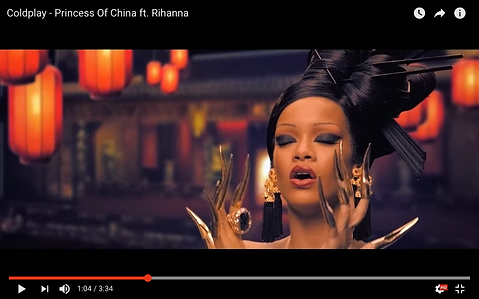
Firstly, Rihanna is supposedly playing the character of a “geisha assassin” as described by the directors of the film. This is a misrepresentation of a culturally symbolic personage and destroys the historical background of geishas – highly intelligent courtesans trained in music, dance and poetry – by signifying her as a sexualized and exoticized object to be commodified by the West and therefore reducing their status to mere objects of desire. Secondly, the intended hyper-sexualization of the Asian-inspired traditional garments that Rihanna is seen dancing provocatively in such as the hakama which is a type of traditional Japanese clothing worn by samurais, and what I can only assume is a highly stylized version of a kimono, designed to be incredibly revealing distorts the way the exploited culture is or can be seen. This type of appropriation ‘‘can have corrosive effects on the integrity of an exploited culture because the appropriative conduct can erroneously depict the heritage from which it is drawn.’’ (Essays on Cultural Appropriation, 1997, p. 9) The appropriation and westernization of important far eastern cultural symbols like traditional forms of dress for the purpose of entertaining an audience risks the inevitable falsification of the way the culture is understood and viewed if continuously disseminated.
The cultural text that I have chosen is one of many examples modern day outcomes of the Orientalist discourse. The misappropriation and exaggeration of cultural traits and practices for entertainment purposes builds and maintains an image of the East as the perpetual ‘other’ and reinforces Orientalism. It further removes the authority of the East to represent and define itself as anything other than antithetic to the normative West. This is why I think cultural texts such as the Princess of China music video is far from a homage to the Asian cultures in depicts as it bears little resemblance to the culture from which aspects of the video are appropriated, distorts cultural identities resulting in erroneous perceptions and attitudes towards said cultures and perpetuates racist stereotypes.
Word count: 1210
Bibliography
Akita, K. (2006) Orientalism and the Binary of Fact and Fiction in Memoirs of a Geisha. Global Media Journal. 5 (9), pp. 1-11.
Foucault, M. (2010) Archeology of Knowledge. 1st edition. London: Routledge.
Hook, D. (2001) Discourse, Knowledge, Materiality, History. Theory & Psychology. 11 (4), pp. 522-543.
Iwamura, J. (2010) Virtual Orientalism: Asian Religions and American Popular Culture. Journal of Global Buddhism. (13), pp. 27-30.
Kim, M. & Chung, A. (2005) Consuming Orientalism: Images of Asian/American Women in Multicultural Advertising. Qualitative Sociology. 28 (1), pp. 67-91.
Mayuzumi, K. (2014) Navigating Orientalism: Asian Women Faculty in the Canadian Academy. Race Ethnicity and Education. 18 (2), pp. 277-296.
Nika, C. (2012) Inside the Style of Rihanna and Coldplay's 'Princess of China' Video. [online]. Available at: http://www.rollingstone.com/culture/news/inside-the-style-of-rihanna-and-coldplays-princess-of-china-video-20120823 [Accessed 10/02/2017].
Rogers, R. (2006) From Cultural Exchange to Transculturation: A Review and Reconceptualization of Cultural Appropriation. Communication Theory. 16 (4), pp. 474-503.
Said, E. (2003) Orientalism. 1st edition. London: Penguin Books.
Stills from: Coldplay Official. (2012) Princess of China. Youtube [video]. 02 June. Available at: https://www.youtube.com/watch?v=1Uw6ZkbsAH8. [Accessed 10/02/2017].
Yegenoglu, M. (1998) Veiled Fantasies. 1st edition. Cambridge: Cambridge University Press.
Ziff, B. & Rao, P. (1997) Borrowed Power: Essays on Cultural Appropriation. 1st edition. New Brunswick, N.J.: Rutgers University Press.
Comments
Post a Comment